

Is Your Business Ready for AI Automation?
January 21, 2026
Custom Website vs Template Website: Which One Is Better for Your Business?
February 18, 2026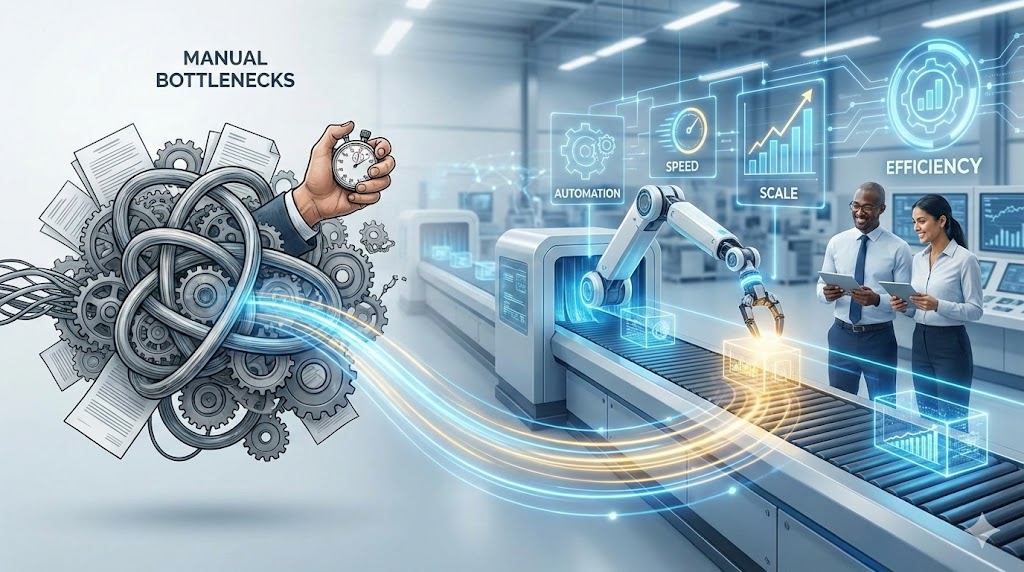
Efficiency in modern industries is no longer about pushing teams to work harder.
It’s about removing friction from how work gets done.
Automation plays a critical role in helping businesses streamline operations, reduce errors, and scale without increasing complexity. Companies that adopt automation gain speed, consistency, and control. Those that rely on manual processes struggle to keep up as operations grow.
Here’s how automation directly improves efficiency across modern industries.
Eliminates Manual Bottlenecks
Manual processes slow operations by default. Tasks wait for approvals, information gets lost between systems, and work stalls due to human dependency.
Automation removes these bottlenecks by:
- Automatically triggering workflows
- Transferring data between systems without manual input
- Ensuring tasks move forward without delays
This results in smoother operations and faster turnaround times.
Reduces Errors and Rework
Human error is one of the biggest causes of inefficiency. Mistakes lead to rework, delays, and higher operational costs.
Automation improves accuracy by:
- Standardizing workflows
- Reducing repetitive data entry
- Enforcing rules consistently across processes
As businesses scale, error reduction becomes a major driver of efficiency.
Speeds Up Decision Making
In modern industries, speed matters. Delayed information leads to delayed decisions.
Automation enables:
- Real-time data visibility
- Automated alerts and notifications
- Faster approvals and escalations
This allows teams to act immediately instead of reacting after problems escalate.
Improves Use of Time and Talent
Automation is not about replacing people.
It’s about using human effort where it creates the most value.
By automating repetitive tasks, businesses can:
- Free teams from low-value manual work
- Improve productivity without increasing headcount
- Reduce burnout caused by repetitive processes
Efficiency improves when people focus on strategic and creative work.
Enables Scalable Operations
Manual systems break down as volume increases. Automation allows operations to scale without chaos.
Automated processes:
- Handle higher workloads without performance loss
- Maintain consistency across teams and locations
- Support growth without operational disruption
This makes automation essential for businesses planning long-term growth.
Increases Visibility and Control
Efficiency depends on visibility. Without clear insights, optimization becomes guesswork.
Automation provides:
- End-to-end process visibility
- Clear accountability across workflows
- Data-driven performance measurement
Better visibility leads to smarter decisions and continuous improvement.
Conclusion
Automation improves efficiency by simplifying execution, reducing errors, and enabling scalable operations.
Modern industries use automation to:
- Increase speed and accuracy
- Optimize resource utilization
- Maintain control as operations grow
Efficiency is no longer optional. Automation is the foundation that supports sustainable growth.