

Beyond Keywords: The New Era of SEO & Marketing in 2025–2026
October 17, 2025
From SEO to AEO: How AI Search is Transforming Visibility
November 8, 2025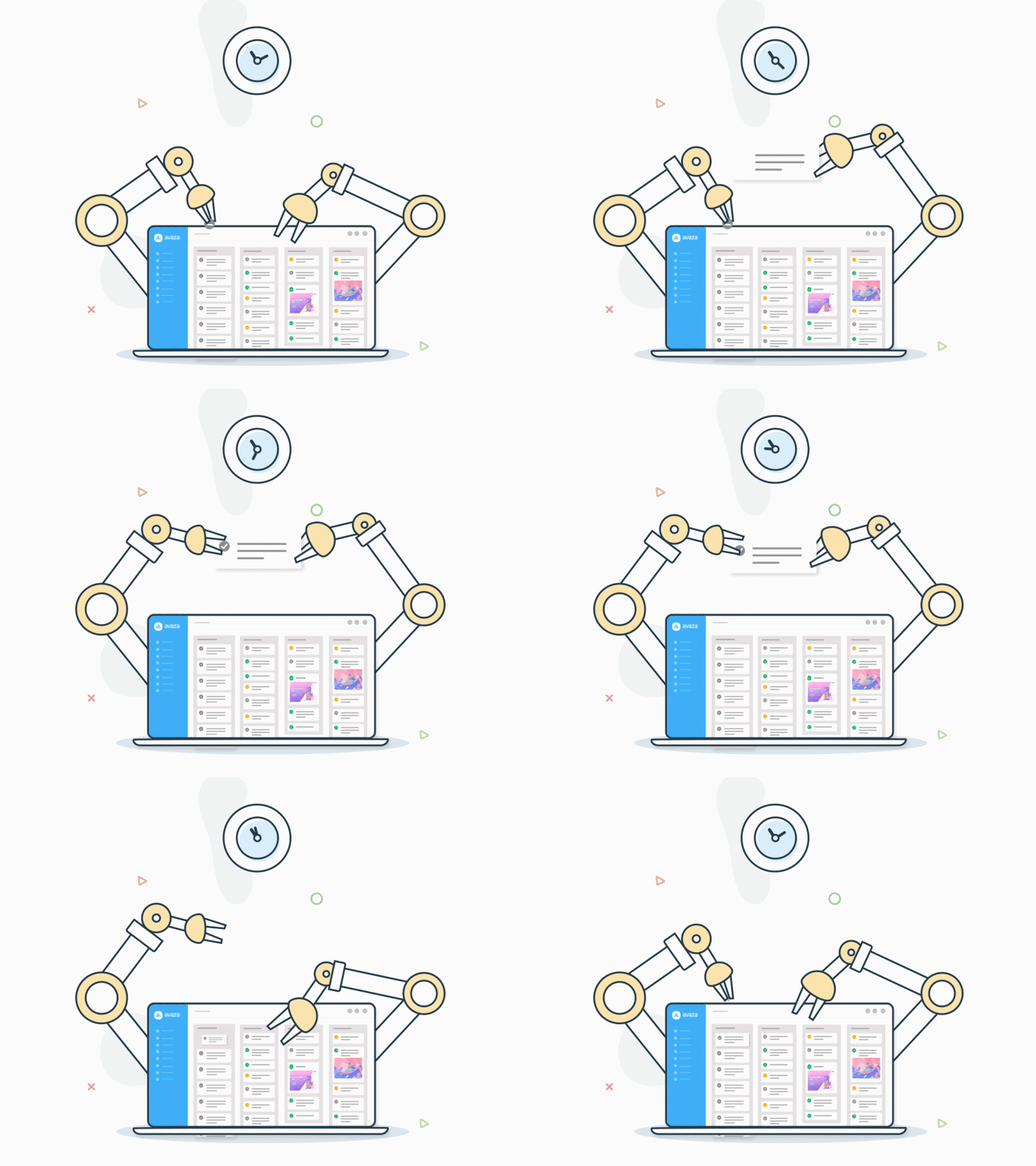
Introduction
In a business world defined by speed, precision, and adaptability, efficiency is no longer optional — it’s essential.
Companies still managing operations manually face delays, human errors, and scalability challenges. That’s where Business Process Automation (BPA) comes in — enabling seamless, tech-driven workflows that cut costs, boost accuracy, and drive growth through data-backed decisions.
With 2025 introducing smarter, AI-powered automation, BPA isn’t just about replacing manual work — it’s about reimagining efficiency and empowering better decision-making.
⚙️ What Is Business Process Automation (BPA)?
BPA uses software and digital tools to automate repetitive, rule-based business tasks — connecting departments and systems for a more unified workflow, helping leaders to make informed decisions.
Instead of employees spending hours on manual approvals, data entry, or reports, BPA ensures these happen automatically — improving accuracy and freeing people to focus on strategic goals and faster decisions.
🚀 How BPA Enhances Efficiency (With Real-World Examples)
1️⃣ Streamlined Workflows
Automation removes manual steps, accelerates processes, and reduces errors.
Example:
A logistics company automates its order-to-delivery pipeline — from inventory checks to invoices — saving hours per transaction and enabling quicker decisions on order fulfillment.
2️⃣ Reduced Human Error
With automation, data entry and reporting become consistent and reliable.
Example:
Finance teams use BPA to automate invoice processing and expense approvals — cutting down on duplicate or late payments and improving financial decisions.
3️⃣ Time & Cost Savings
Automating repetitive tasks reduces overhead and allows teams to focus on core business goals.
Example:
HR departments automate onboarding — system access, document verification, and training — reducing the process from 5 days to 1 and supporting faster HR decisions.
4️⃣ Real-Time Insights
Automated dashboards deliver live data for faster, smarter decisions.
Example:
Retail chains automate inventory monitoring — automatically triggering restock orders when levels drop below a threshold, leading to timely decisions that prevent stockouts.
5️⃣ Higher Productivity & Employee Engagement
With routine work handled by automation, employees focus on creative and analytical tasks — boosting engagement, innovation, and better internal decisions.
6️⃣ Scalable Growth
As business volume grows, BPA ensures operations remain efficient.
Example:
A fintech automates KYC verification and customer onboarding, scaling operations 3x without extra manpower and improving scalability decisions.
🔮 Latest BPA Trends & Updates
AI & Machine Learning Integration
BPA is evolving from rule-based to intelligent automation.
AI enables systems to make decisions, detect anomalies, and predict next steps.
💡 Example: AI-driven chatbots now handle document processing, ticket routing, and approvals autonomously, ensuring faster operational decisions.
Low-Code / No-Code Platforms
Tools like Power Automate, Kissflow, and Zapier empower “citizen developers” — enabling non-technical staff to design workflows and make automation decisions without IT dependency.
Ecosystem Orchestration
Businesses are now connecting entire ecosystems — CRM, ERP, HRMS, and marketing tools — for end-to-end automation that unites systems and decisions.
Intelligent Document Processing (IDP)
Using OCR and NLP, systems can now automatically extract and classify data from invoices, forms, and emails — reducing manual data work by 80% and accelerating information-based decisions.
Governance & Security
As BPA expands, data security, audit trails, and compliance become crucial. Organizations are adopting ethical automation frameworks to ensure safe and transparent decisions.
Human-Centric Automation
Automation is being designed around people — improving employee satisfaction and customer experience, rather than merely replacing human effort — helping balance human and machine decisions.
📘 Real-World Use Case: AI-Driven BPA
A leading service firm implemented AI-assisted BPA for client onboarding.
Pre-automation: Manual document review and setup took 3 days.
Post-automation: AI scanned, verified, and processed data in 6 hours.
Result: 70% time saved, error rate reduced by 40%, and team bandwidth improved for higher-value projects and strategic decisions.
This demonstrates how AI + BPA is redefining efficiency benchmarks and decision-making agility in 2025.
🧭 How to Implement BPA for Efficiency
Here’s a roadmap to apply automation effectively and make smarter decisions:
-
Identify repetitive, high-volume processes
-
Select the right tools (AI-driven, secure, scalable)
-
Start small and scale smart
-
Focus on data quality & governance
-
Track metrics – time saved, ROI, error reduction
-
Empower teams with training & adoption support
-
Continuously optimize with process analytics
🌟 Conclusion
In 2025, Business Process Automation isn’t a luxury — it’s the foundation of operational excellence.
By blending AI, analytics, and low-code automation, businesses can achieve efficiency that scales effortlessly — powered by real-time data and confident decisions.
Work smarter. Deliver faster. Grow stronger — with BPA-driven success.